Friday, November 18, 2011

Brachythecium curtum


Name: Brachythecium curtum
Common name:  n/a
Family:  Brachytheciaceae
Collection Date
Habitat: On moist surface of small rock, near Chagrin River
Location: South Chagrin Reservation
Description: Flattened, light green mat of moss
 Collector: Janie Lawson

Key used: Conard, H.S. and P.L. Redfearn, Jr. 1979. How to Know the Mosses and Liverworts 2nd Edition, McGraw-Hill, Boston, Mass.
Keying Steps:
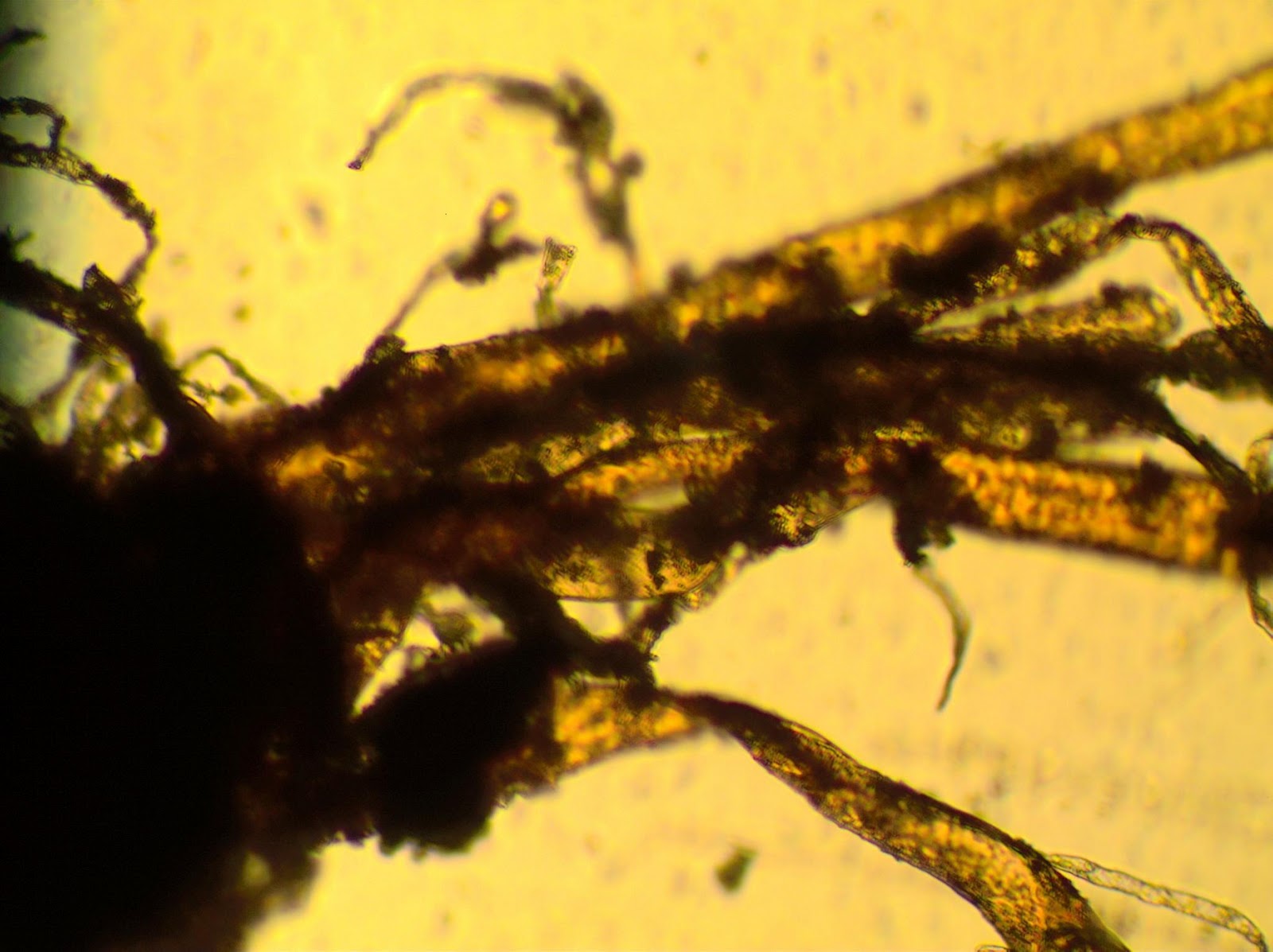
Introduction Key pg. 19
1b.Plants with stems and leaves, leaves equally spaced around stem…Class III Musci…2
2b. Plants not having many spreading recurved branches and leaves with two types of cells…3
3b. Plants not in reddish brown tufts…Subclass Bryidae

Key to Families/Genera of Bryidae pg. 28
1b. Green plants; if empty cells occur only at base, apex, or margin of leaf...3
3b. Leaves in three or more rows, but sometimes flattened...7
7b. Plants with peristome of more than 4 teeth, gemmae when present not arranged in cup...8
8b. Leaves well developed and persistant...9
9b. Plants not having sessile, inclined, asymmetric, immersed capsule ...10
10b. Plants with or without a distinct stem; capsule when presnt with an operculum; may or may not be ephemeral....17
17b. Plants minute to large, capsules, immersed to exserted; if minute with immersed capsules, growing on rocks, trees, or soil and not ephemeral...20
20b. Plants without photosynthetic growths on leaves…28
28b. Peristome single or double; growing on various substrates, but not restricted to rich organic soil or other organic matter…33
33b. Stems creeping or branching, usually extensively branched in interwoven mats…139
139b. Leaves smooth, more or less glossy…174
174b. Paraphyllia or multicellular propagula few or none, usually not seen…182
182b. Costa single and strong, to short and/or double to absent…183
183b. Costa single, reaching middle of leaf or beyond, or short and/or double…184
184a. Costa single, reaching middle of leaf or beyond…185
185b. Terrestrial, on wet or dry substrate, usually not submerged…192
192b. Plants not dendroid…193
193b. Leaves not distinctly bordered…194
194b. Leaves narrowly lanceolate to ovate…196
196b. Leaves ovate to lanceolate, rarely falcate, never circinate…197
197b. Median leaf cells elongate…214
214b. Shoots not complanate-foliate…216
216a. Alar cells clear, thin-walled, inflated…217
217b. Leaves pointed at apex…218
218a. Inflated alar cells broadly decurrent…Brachythecium

Key to Family Brachytheciaceae- Genus Brachythecium
1b. Leaves not plicate…8
8a. Leaves straight, not second…9
9b. Narrow leaves, ovate-lanceolate  or triangular-ovate, to long acuminate; seta smooth or rough…11
11b. Costa not extending more than 2/3 the length of the leaf…13
13a. Branch leaves twisted at apex…Brachythecium Curtum

Plants moderate in size, in loose, shiny, yellow or light green mats, stems ascending or arched, irregularly branched, on various substrates, often in bogs; Minnesota to Nova Scotia south to North Carolina and Tennessee

Links: http://193.166.3.2/pub/sci/bio/life/plants/bryophyta/bryopsida/bryales/brachytheciaceae/brachythecium/index.html

Monday, October 17, 2011

Atrichum

 
  1.Plants with stems and leaves… 2
  2.A) Leaves equally spaced around stem, or in two ranks with a midrib… Musci (p. 23)

1.   B) Gametophytes present with obvious leaves… 2
2.  B) Leaf cells of one kind (green), or if of two kinds, branches never in clusters...3
3. B) Leaves attached all around the stem (foliate stems sometimes flattened [complanate])…7
7. B) Leaves without lamellae or filaments on the adaxial surface of the costa (but propagula sometimes present)…23
23. B) Leaves never lobed, flattened (although sometimes concave with margins inrolled or recurved)…24
24. Leaves with a single costa to at least midleaf…114
114. B) Plants prostrate to erect, simple to pinnately branched…121
121. B) Plants greenish to blackish, on various substrates; capsules cleistocarpous or operculate, never valvate...123
123. B) Leaves erect to squarrose; plants occurring in various habitats…124
124. Stems with paraphyllia..125
142. B) Plants greenish to blackish, rarely whitish; leaves usually with conspicuous lamina, if not green cells and hyaline cells of about equal size with only a single layer of hyaline cells on either side of the green cells…144
144. B) Leaf margins plane to recurved…149
149. B) Plants mostly larger, occurring on various substrates, mostly not ephemeral, or if so, capsules exserted… 161
161. B) Neck of capsules considerably narrower than urn; occurring on various substrates…164
164. B) Leaves all of one kind…166
166. B) Capsules operculate; plants rare to common…169
169. B) Cells without nodulose-wavy walls, or if present only near insertion…170
170. B) Leaves without hair-points, or if with hairpoints not hyaline…181
181. B) Costa narrower, or if broad then ending below the leaf apex and not filling it (or if broad then pleurocarpous)…187
187. B) Plants acrocarpous (sporophytes terminal); stems erect, not branched or occasionally branched beneath inflorescences…280
280. Capsules large, sessile, asymmetric…281
281. B) Costa smooth or toothed at back, not ridged…283
283. B) Rhizoids inconspicuous or if obvious, never obscuring the stem…287
287. B) Plants greenish, occurring in various habitats, rarely on wet rocks by streams, with or without propagula…290
290. B) Hyaline basal cells if present extending more or less equally up the margins as costa or farther up the costa…293
293. B) Plants not glaucous or bluish…294
294. Leaves bordered by 2 or more rows of elongate cells…295
295. B) Leaf margins toothed…300
300. B) Leaves without expanded base, without hyaline cells…301
301. B) Leaf margins with paired teeth…302
302. B) Leaf cells flat…303
303. Some leaves with low, inconspicuous lamellae; costa in transverse section with two stereid bands; peristome of 32 small teeth attached at tips to a tympanum… Atrichum

Platygyrium

  1.Plants with stems and leaves… 2
2.A) Leaves equally spaced around stem, or in two ranks with a midrib… Musci (p. 23)

1.   B) Gametophytes present with obvious leaves… 2
2.  B) Leaf cells of one kind (green), or if of two kinds, branches never in clusters...3
3. B) Leaves attached all around the stem (foliate stems sometimes flattened [complanate])…7
7. B) Leaves without lamellae or filaments on the adaxial surface of the costa (but propagula sometimes present)…23
23. B) Leaves never lobed, flattened (although sometimes concave with margins inrolled or recurved)…24
24. Leaves without a costa or costa short and double, double, or single with 2-3 lateral spurs…25 
25. B) Lamina unistratose…27
27. B) Upper leaf cells smooth…46
46. B) Leaves concolorous at apex…48
48. Plants sometimes in wet habitats but never occurring submerged; leaves various but never keeled…49
49. B) Plants pleurocarpous, mostly larger…53
53. B) Costa always double, or if single very short and without supplementary costae…54
54. B) Costa short and double, usually ending just above leaf base…59
59. B) Leaves acute to acuminate, at least apiculate; plants mostly larger, widespread…61
61. B) Leaf cells firm- to thick-walled, rounded to linear…63
63. B) Leaves not at all decurrent to broadly auriculate…64
64. Plants larger; leaves more than 1 mm long…67
67. Leaves falcate-secund.
68. Leaf cells more or less linear…70
70. Plants irregularly pinnate to unbranched, not feather-like; stems prostrate to loosely ascending…71
71. Mature branches erect and producing abundant and conspicuous propagula in their upper leaf axils… Platygyrium

Key: http://www.mobot.org/plantscience/bfna/V1/KeyToMosses_2.htm